

Living well is not complicated.
Most people need most of these 7 things to flourish:
Family
Especially your immediate family; you’ll need good relationships with your parents, siblings, and any other family you have strong bonds to.
Friendships
These are people you enjoy spending time with, want to see again, or can otherwise rely on for a favor.
Hobbies
Things you do for fun. Reading for pleasure, watching your favorite show, playing with your dog or listening to music.
Health (Mental, Physical)
A decent diet, regular physical exercise, fair amount of sleep, and stable state of mind.
Romantic Relationship
A partner or spouse who you do life with and are totally honest with. Ideally you feel in love with this person, but the most important kind of love is actually the act of loving one another.
Faith
Time in prayer and sense of nearness to God. Also related are your sense and awe toward God and His creation and your level of belief i.e. credence in God and His promises.
Work
Most people spend 80,000 hours at work in their life. It’s worth it to find work that motivates you and has meaning and impact. Being a full-time student or caretaker can count as work.
To live well, most people need most (4+) of these to be going well.1
Those with 3 or less lead unbalanced and (often) unhappy lives.
A Made-up Example: Jessi

Jessi has a stable job that he enjoys and pays well. He is in fair health and has an active hobby of travel and a dog.
But he lacks a stable romantic partner, belief in God and an active prayer or meditation routine. He lacks good friends and his family is quite chaotic and disharmonious.
Jessi has 3 of the 7 — not enough.
Most Jessis I meet are modestly unhappy and discontent.
When money matters
Jessi has a high-paying job, earning $150k a year.
Can that make up for the things he doesn’t have?
Despite how often people in society sacrifice aspects of the 7 for money, money itself is not actually what people need.
0’s in a bank account don’t add improve your wellbeing.
But money is an instrumental good toward the seven.
Money can be used to:
Support family in need.
Subsidize expensive hobbies. Skiing is a lot of fun and costs a lot of money.
Start new friendships via shared hobbies and social circles.
Support health. Fresh, less-processed meals are more expensive, as are gym memberships, trainers, and psychiatrists.
Impress partners. Women (on average, all-else equal) prefer partners who have more money and provide them nice things. Men don’t mind it either.
Gives work flexibility. Most people work to live. Those with money can live to work. They can accept a lower-paying job in favor for one with better conditions, more meaning and more impact. Great runway also helps you weather job transitions so that you don’t out of necessity accept a job you don’t like.
Money helps all these areas, if spent well.
There is one exception: faith.
More money less God
More money (on average) actively harms one’s faith.
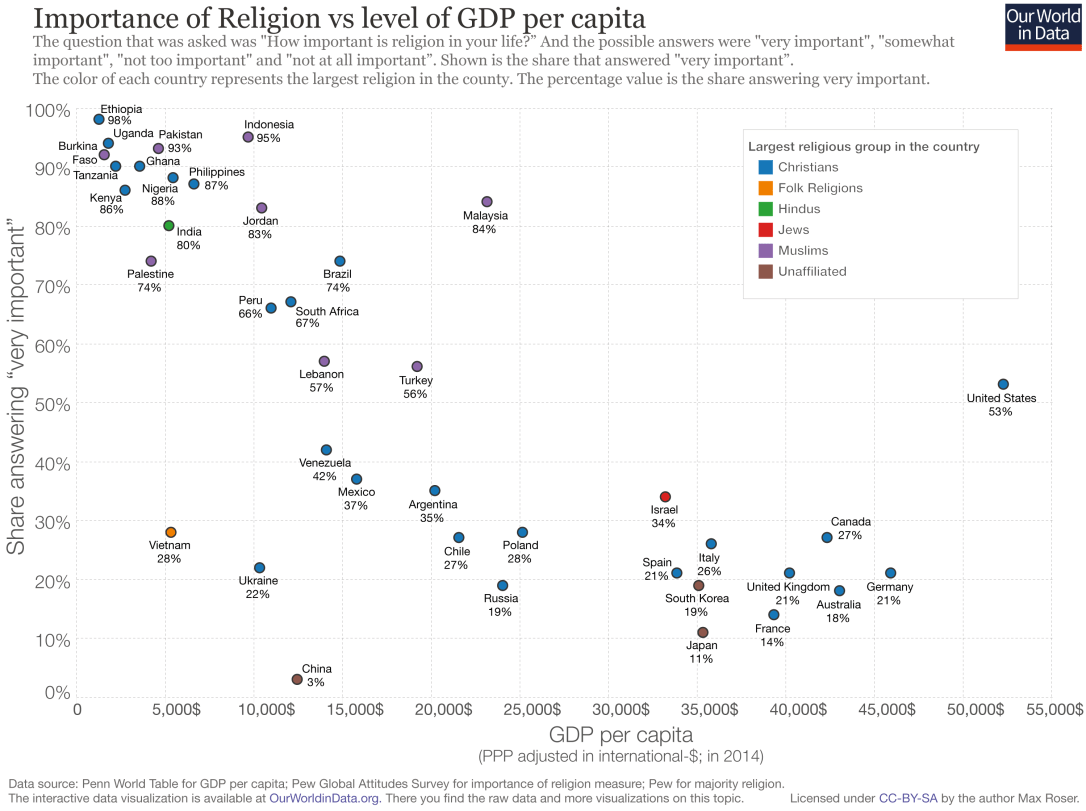
This also fits with scripture:
“You cannot serve God and money” (Matt 6:24)
“Blessed are you who are poor, for yours is the kingdom of God. Blessed are you who hunger now, for you will be satisfied” (Luke 6:20-21).
While it’s not necessarily a sin to be rich, having more money tempts one away from dependence on God and, on average, leads people towards lower levels of faith.
This is one reason why radical, effective generosity is spiritually vital.
But what about … ?
People invest considerable time and effort to things that are not in the seven:
Nice car
Bigger house
Physical appearance
Status
Graduate degrees
Niche skills
At best, these are instrumental goods to the seven. At worst, these are idols and dangerous distractions.
As with money, think about whether or not these things effectively contribute to the Seven, for you or for someone else.
How does doing good fit in?
Charity and doing things for impact might be considered part of the seven.
Giving away 10%+ of your lifetime income might be an important dimension of your faith. Having an impact might be important to you for your work.
But at the end of the day, doing good isn’t about you or your seven; it’s about someone else. And at a small sacrifice to your Seven, you can greatly improve someone else’s.
For instance, assuming flexible hours, you could work 1 extra day a year to provide enough funds to protect 300 children from developing parasitic stomach worms.
Small cost to your work-life balance. Big benefit to the health of many. Human flourishing goes up.
Normal ways things get unbalanced

Our lives become unbalanced when we put too much time in one bucket of the seven.
We wander into new life stages and assume the rest of the seven will continue as before.
Here are some common examples of where that can go wrong:
you get a new job - our work takes up almost all of our time and sometimes it leads you to neglect your friends, spend less time with your partner, skip the gym, etc…
you move out of state - your rhythms, jobs, friendships, church and everything else gets thrown out of order…
you get a baby - you take time off work, stop exercising and get poor sleep, don’t go out to see friends, and skip church for a year…
you become obsessed with someone - you start a new romantic relationship, investing all your time in the other person and their interests and relationships, in ways that don’t support your own…
you become addicted to a hobby - you reinstall a video game from your childhood which was designed by experts to be maximally-effective at engaging you and stealing your attention from other life matters…
Good pastors will intervene when they see one area of life unduly cannibalizing all others, as this is a kind of idolatry.
When to Ignore This Advice
Case 1: Wartime

Sometimes people have a good reason to neglect the 7.
For instance, in wartime people leave their spouses, their hobbies, their families and their day-jobs to join the military. They may also sacrifice their health and minds in order to fight for their cause.
Of course war is awful. But sometimes necessary.
Case 2: Mission
Another example is when someone creates a charity or company or a mission for the Gospel.
This might involve a similar totalizing sacrifice as war (but with less risk to physical health).
And it might be worth it.
Your mission might have X% chance at advancing God’s kingdom in a very serious way. You might be specially called by God towards a particular task and it might be worth placing everything to the side.
I’d guess that most of people are not called to this kind of mission.
But some people are.
If that’s you, seek first God’s kingdom and focus one day at a time.
A friendly warning
Before sacrificing some of the 7 for an important mission, also consider whether you have your time horizon correct.
You probably have decades more to live.
You may need to save strength and live more balanced now if you are to have energy in the future.
Life (and impact) are not a sprint but a marathon.2
What is this based on?
Since I developed this framework about 6 years ago, I’ve watched closely how it does or doesn’t predict the wellbeing of the people I interact most with.
It seems highly predictive.
My wife and I have made a rule of life of asking about the Seven every week.
We began during COVID times in April 2020 and we discuss it every Sunday for about 30 minutes.
The benefits have been massive.3
This is easily one of the best habits — we expect to do this for the rest of our lives.
There are other biblical and scientific reasons for thinking each of these categories are very significant for wellbeing:
Family
Scripture: Exod 20:12, 1 Tim 5:8
Friendships
Scripture: 1 Thes 5:11, 1 Cor 15:33, Job 6:14, Prov 18:24
Hobbies
Health (Mental, Physical)
Studies here and here and mental health here
Scripture: 1 Cor 6:19
Romantic Relationship
Scripture: Eph 5:21-33
Faith
Scripture: 1 Thes 5:17
Work
Scripture: Gal 6:9, Col 3:23-24
Takeaway: How to improve your life

No matter who you are, you can probably improve your life by simply focusing on some neglected components of the 7.
In Jessi’s case, he would probably be better off if he spent more time and energy focusing on faith, romantic partnerships, friendships, or family.
He can start off be focusing on whichever is most neglected.
Some of this is easy:
Faith: Praying and meditating for 20-30 minutes a day. Giving away 10-20%+ of his income to effective charities.
Family: Calling important family members each week for 10 minutes is *relatively* easy and can sustain relationships.
These are probably easier than finding a good partner or making a best friend (these may be worthwhile but take even more time and work).
To get started, reflect on these questions about your life:
When things were best, how did you do on each of the seven?
How about when things were worst?
How are things now?
What are you underweighted in and could most easily restore?
I put this out there as something that is descriptively true for most people, not as a prescription for how everyone ought to weigh their lives.
It’s also worth the reminder that you shouldn’t lie, cheat or steal to obtain your goals.
Discussing the Seven weekly also helps us to make big decisions. I was convinced I should marry Madeline after realizing that my life was better in almost every dimensions with her than without her. This framework also helped us know whether to accept a new job or move to a new city. For example, we decided to move to Washington DC after making a simple weighted model on how moving to various cities would affect the Seven. Before the model, we were uncertain. After the model, it was clear DC would be almost as good as every other city but much better for our work and hobbies.
Excellent summary, thank you! Keep up the good work😎